

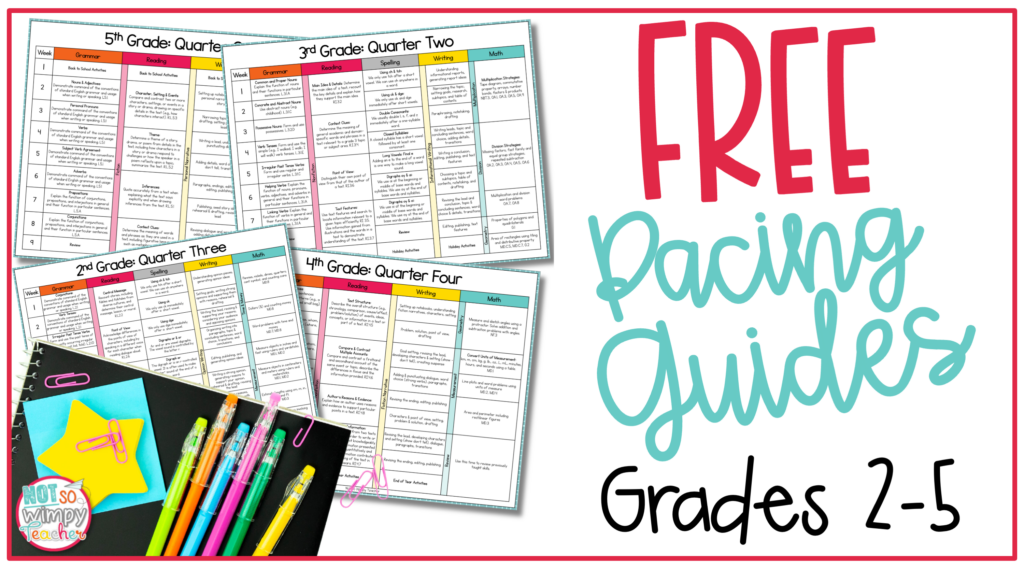
There are so many things you need to teach your students every year. So many subjects, so many skills, so many standards. And you need to teach it all before state testing, which often occurs a month or two before the end of the school year. It’s no wonder that teachers often worry about how to fit it all in. But you don’t have to worry any longer because today I am sharing my FREE pacing guides with you.
What is a pacing guide?
A pacing guide is a simple document that tells you what you’ll teach each week of the year. It’s also sometimes called a curriculum map. This is actually a great name because a pacing guide truly does map out all your content for the year.
The first time I saw a pacing guide was when my district gathered a few teachers from each grade level and had us create yearlong pacing guides for reading, writing, and math. The process itself was challenging, but when we were done my mind was blown! I had my own map to help me pace out my lessons for the entire year.
When the pacing guide said I had three weeks to work on fractions, then I knew I had three weeks to spend on that unit – no more, no less. There was no guessing and scrambling. All I had to do was follow the map.
A pacing guide is not a detailed lesson plan or schedule, but it does provide a much-needed general overview of what you should be teaching and when so you can gauge whether or not your lessons are on track.
If you follow the pacing guide, you’ll be sure to cover all the required content over the course of the school year. No stress required.
How to use a pacing guide
A pacing guide is a great way to make sure your lessons are on track for the year. But remember, it just provides the big picture view of what you should be teaching each week. It doesn’t get into nitty-gritty details.
A pacing guide does, however, make planning those individual lessons so much easier.
Is Your TPT Wishlist Getting Too Long?
First, it provides a guide for what types of lessons you need to plan each week. Instead of wondering whether to teach pronouns or adjectives, all you have to do is look at your pacing guide and see what’s scheduled for the week.
It also saves time determining how long to teach a unit. You don’t have to guess whether you’ll need two weeks or three to teach division. You can look at your pacing guide and get a definitive answer.
This is particularly important if you love teaching one topic and don’t really care for another. Say you really like teaching opinion essays but don’t really enjoy informational reports. Rather than extending the amount of time you spend on persuasive writing and running out of time to teach informational reports, a pacing guide helps keep you on track.

Pacing guides make lesson planning easier
When it comes to planning individual lessons, all you have to do is grab your pacing guide and your teacher’s manual. Check the date, figure out what weeks you are planning for, and then find those weeks on your pacing guide.
If the guide says you are teaching perimeter and area, you can just flip to that section of your math textbook and begin planning accordingly. No more wasted time deciding what to teach.
Pacing guides are also a terrific tool if you batch your lesson plans. You can look at your pacing guide and see that the next three weeks are all focused on teaching the main idea. When it’s time to lesson plan, you can sit down and plan all your lessons (all three weeks worth) on main idea in one planning session. I talk more about batching your lesson plans here and in my book How to Love Teaching Again.

FREE Year-Long Pacing Guides for Writing, Reading, Grammar, and Math
I know not every school district provides teachers with pacing guides. So I went ahead and made them for you! Yep, I created FREE Year-Long Pacing Guides for grades 2-5
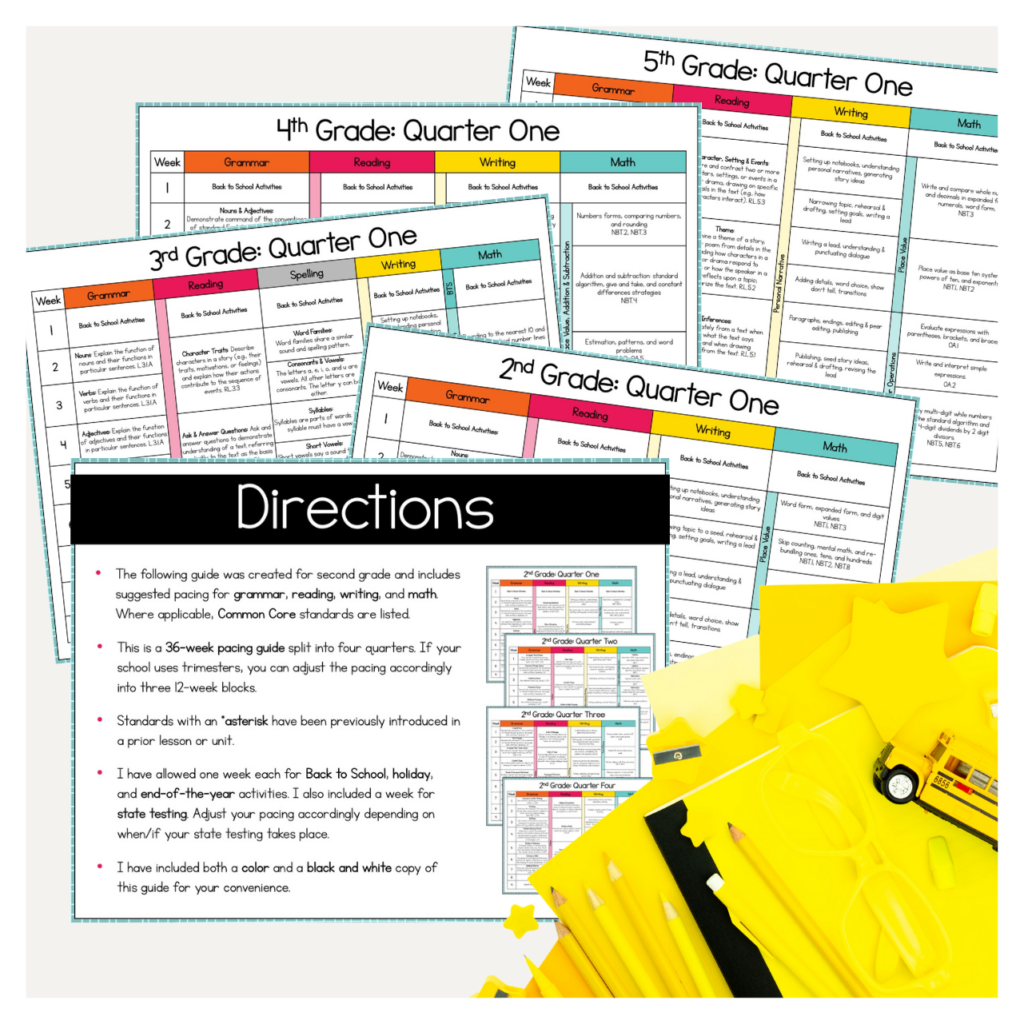
My FREE Year-Long Pacing Guides for grades 2-5 make it easy to plan your entire year of reading, writing, grammar, and math lessons. Each of these pacing guides:
- Include writing, grammar, reading, and math
- List Common Core Standards, when applicable
- Are divided into four quarters
- Make time for back-to-school, holidays, state testing, and end-of-the-year activities
- Come in color and black and white
You can use your pacing guide over and over each year. To make it even more helpful next year, take notes about skills and concepts that take more or less time than expected.
I’ve also included a blank pacing guide template.
Tips & tricks for using pacing guides
- Your pacing guide includes general topics or big ideas, not individual lessons.
- Your pacing guide is meant to be just that, a guide. It’s not set in stone. Feel free to modify it as necessary to fit your own unique classroom needs and schedule.
- A pacing guide is a great way to ensure that grade level teams are covering the same skills. While you don’t all need to teach the exact same lessons, sticking to a common pacing guide ensures that every student is learning the same skills.
- Use your pacing guide each week to make lesson planning a breeze.
- If and when you fall behind, don’t worry! The pacing guide makes it easy to see how much you still have to cover and makes it easy to make adjustments to get back on track.
- Use your pacing guide in conjunction with checklists or other assessment tools to make sure your students are actually learning the skills identified in the pacing guide.
- Pacing guides are flexible and you can easily adjust your pacing to meet the unique needs of your students.
Don’t forget to grab your FREE Pacing Guide here!

Have a Not So Wimpy Day,






 Thanksgiving Project-Based Learning Math Activities for Grades 2-5
I love pacing guides and love your layout, unfortunately, our district is not the same and I am grade level chair and looking to revamp ours. Every few years the district changes things just a tad bit and we have to create or rearrange our year. That happens to be this year. Is there a way for me to get an editable template? Yes I love your book!
I was wondering the same thing. I also wanted to be able to add a column for our social studies/science standards. Would that be a possibility?
With appreciation for all of your hard work!
I was also wondering the same thing! I loved your book and want to use as much of your resources as I can to make lesson planning easier! Is it possible to get an editable template?
Hi! I’m sorry, there is not an editable template available. I hope the content will be helpful even if you can’t use the format.
Do you have pacing guides for jr and High school?
Hi Steve,
Thanks for asking! Not So Wimpy Teacher only creates resources for grades 2-5 because those are grade levels we have the most experience teaching. I am sorry, we do not have pacing guides for junior and senior high school.
I have tried to sign up for the pacing guides but have not received them.
Pacing guides are quite useful for new teachers or those who tend to “overdo” a particular topic. Having an overall roadmap for the entire year makes teaching clearer, less stressful, and avoids the pressure of meeting deadlines. With such a framework, teachers can also flexibly design activities for students, even incorporating simple games like Italian Brainrot Clicker to create a relaxed atmosphere without deviating from the schedule. Overall, this is a very worthwhile tool to use long-term.
thanks post
I love how the pacing guides are divided into quarters and include time for holidays and testing, it’s like having a roadmap for the whole year. I actually used one last week while planning my math lessons, and it made everything so much smoother.
I love how the pacing guides are divided into quarters and include time for holidays and testing, it’s like having a roadmap for the whole year. I actually used one last week while planning my math lessons, and it made everything so much smoother.
Thanks for these free pacing guides! They’ll really help with lesson planning this year. After a long day of teaching, I like to unwind with a fun game like storm grill game. It’s a great way to relax with some strategic gameplay!
I love how the pacing guides are divided into quarters and include time for holidays and testing, it’s like having a roadmap for the whole year. I actually used one last week while planning my math lessons, and it made everything so much smoother.
yes, thanks u
Break down your study sessions: study short but regular periods, avoid marathon study.
tap tap shots
People adore this game for several reasons, one of which is its timeless aesthetic.
retro bowl
Very insightful! Effective planning is one of the best ways to create a more productive classroom. مكتب تقديم جامعات
Very insightful! free online games
This is a true “time-saving bad parenting” version for the four core subjects: Grammar, Writing, Reading, and Math.
This is a true “time-saving” version for the four core subjects: Grammar, Writing, Reading, and Math.
Using the weekly math map for my current unit, I still leave room for baseline checks.
The three-week block for fractions example really drives home how pacing guides eliminate guesswork. I appreciate that you acknowledge they’re guides, not commandments—that flexibility is crucial since every class moves differently. The batch-planning angle is smart too; grouping related weeks lets you prep multiple lessons in one focused session instead of context-switching constantly. I use this guide to cross-reference skill progressions with pacing timelines when things run behind schedule.
These free pacing guides look like such a practical way to save time and stay organized throughout the school year. Having a clear framework for planning lessons can make it much easier for teachers to focus on instruction and their students rather than constantly worrying about what comes next. Thanks for sharing such a useful resource!
These free pacing guides are such a helpful resource for teachers! Having a clear plan for the school year can save valuable time and make classroom preparation much easier. I appreciate the practical tips and resources you share for educators. In my free time, I also enjoy exploring topics like Kolkata FF online. Thanks for sharing these useful teaching ideas!
When state testing arrives well before the school year ends, a pacing guide can do more than divide lessons across a calendar. It can make the tradeoffs visible: which skills need recurring practice, where subjects can reinforce one another, and where there is room to adjust after formative checks. That kind of planning structure is especially useful when standards compete for limited instructional time.
A pacing guide is most useful when it makes tradeoffs visible rather than simply dividing a school year into equal blocks. With many subjects, skills, and standards competing for limited instructional time, teachers need room to revisit concepts and respond to what students need. Planning backward from testing dates can help protect that flexibility, while keeping the scope of each unit realistic and easier to adjust.
When a school year includes many subjects, skills, and standards, the sequencing of lessons becomes as important as the lessons themselves. A pacing guide can turn a long list of requirements into smaller checkpoints and make it easier to see what needs attention before testing dates arrive. Building in a little flexibility is useful too, since the schedule may need adjustment as students move through the material.
Thank you for sharing these helpful free pacing guides! I love how they make lesson planning easier and help teachers stay organized throughout the school year. Such a practical resource for saving time while keeping lessons on track. Thank you for supporting teachers with these wonderful resources!
I really appreciate websites that make information easy to find and understand! Having everything organized in one place saves time and makes browsing much more convenient. I also enjoy exploring topics like Kolkata FF online. Thanks for sharing helpful and easy-to-access information!
I always struggle with fitting everything in before testing! These pacing guides look super helpful for mapping out the year. I think I’ll need to size it up first to see how it fits with my current plans, but anything that saves time is a win in my book!