This fifth grade bundle has tons of resources to help you teach all of the math standards your students need to learn for the entire year. Our comprehensive Fifth Grade Math Units were designed to be teacher and student-friendly. Think of them like your one-stop shop for math lessons that are fun, engaging, and easy to prep.
Math Curriculum Bundle FIFTH GRADE
Save MORE with Lesson GenieMore about this resource
This bundle is an amazing value. Priced individually, these units cost $1.25 per day (which in itself is a heck of a deal). But with the bundle, you get all 10 units, a full year of math curriculum, at a significant discount. This low-prep bundle is quite the deal!
A better way to teach math. Our full-year fifth grade math curriculum includes 10 standards-based units. Easy to prep and use. Fun, engaging & effective.
Not all math curriculum is awful. Just sum. Ba-da-bum!
But when it is bad, it is very, very bad. And unfortunately a lot of traditional math curriculum is very, very bad. It’s overly complex, too long, impossible to differentiate, difficult to manage, and, frankly, not much fun. It can be hard to wade through all the extras and find the most valuable parts of the lesson. You don’t have time to read dozens of pages in the teacher manual and there are way too many different pieces to prep. Ugh!
If that sounds like your math curriculum, you’re in luck. Because now you have an alternative that is very, very good. A math curriculum that you and your students will LOVE!
Introducing the Fifth Grade Math Curriculum Bundle! (Cue the confetti!)
This 5th grade bundle has tons of resources to help you teach all of the math standards your students need to learn for the entire year. Our comprehensive Fifth Grade Math Units were designed to be teacher and student friendly. Think of them like your one-stop shop for math lessons that are fun, engaging, and easy to prep.
There are 10 units in this bundle. And teaching with these units is a breeze. I’ve carefully designed them to follow the same format. You’ll only have to teach the expectations and procedures one time. After that, your students will know exactly what’s coming next in each unit. From mini lessons to centers, small groups to review activities and assessments, they’ll know what to expect. You’ll save so much class time!
The 10 units are organized by topic. Each ready to teach unit comes with everything you need to teach standards-based math skills. The instructional PowerPoint is your complete mini lesson–just project on the board and teach. Daily student activities are effective and engaging–just print and copy for each student. We’ve also included a list of frequently asked questions to address some common concerns and help you troubleshoot.
The At a Glance schedule helps you plan your lessons for the entire unit. Each day includes an instructional PowerPoint and student activity.
What’s Included:
“At a Glance” calendar shows which lesson is being taught each day of the unit.
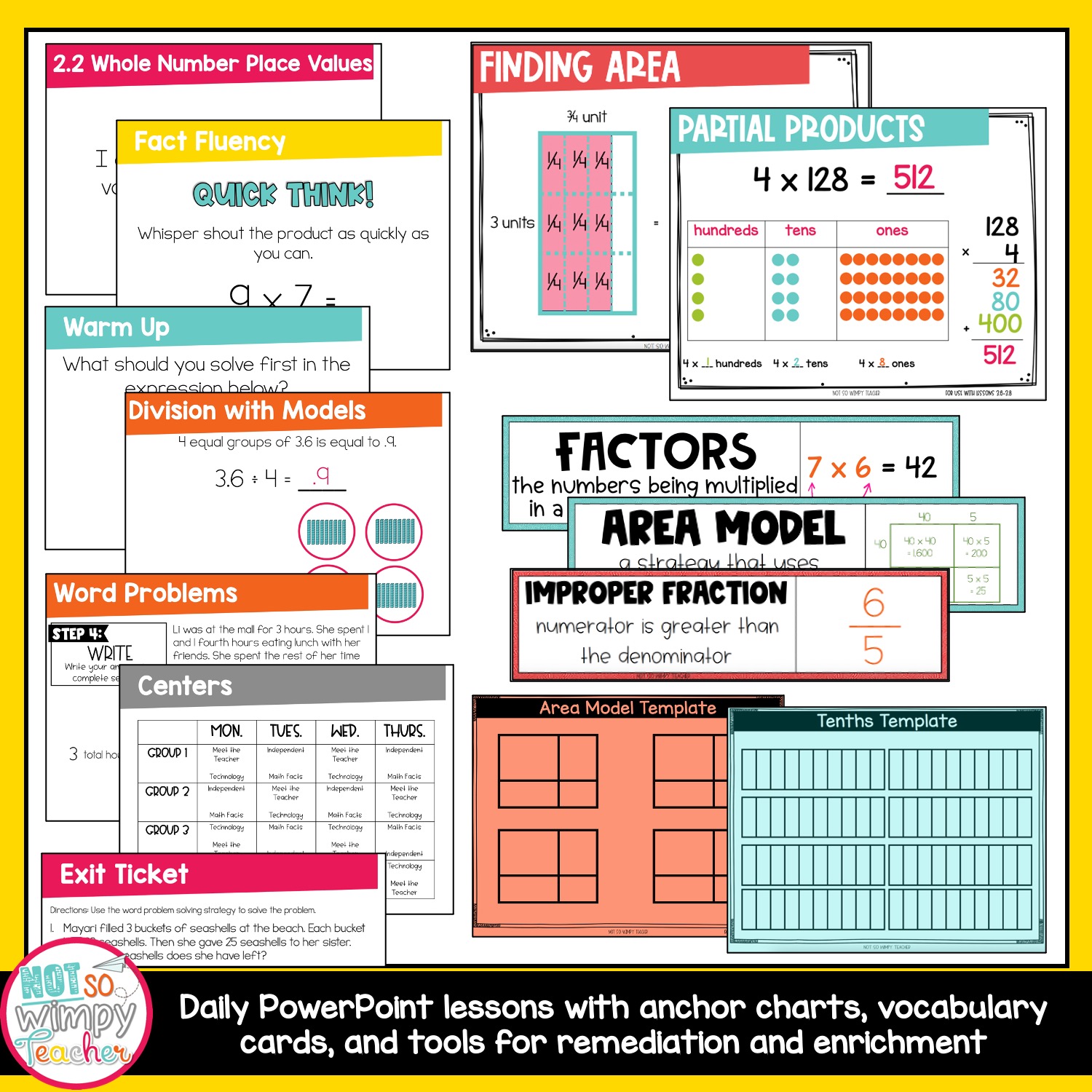
Vocabulary cards help deepen student understanding of academic language and models represented by the terms.
A pre-assessment lets you know what prior knowledge your students already have.
Anchor charts assist visual learners and provide a student reference throughout each unit.
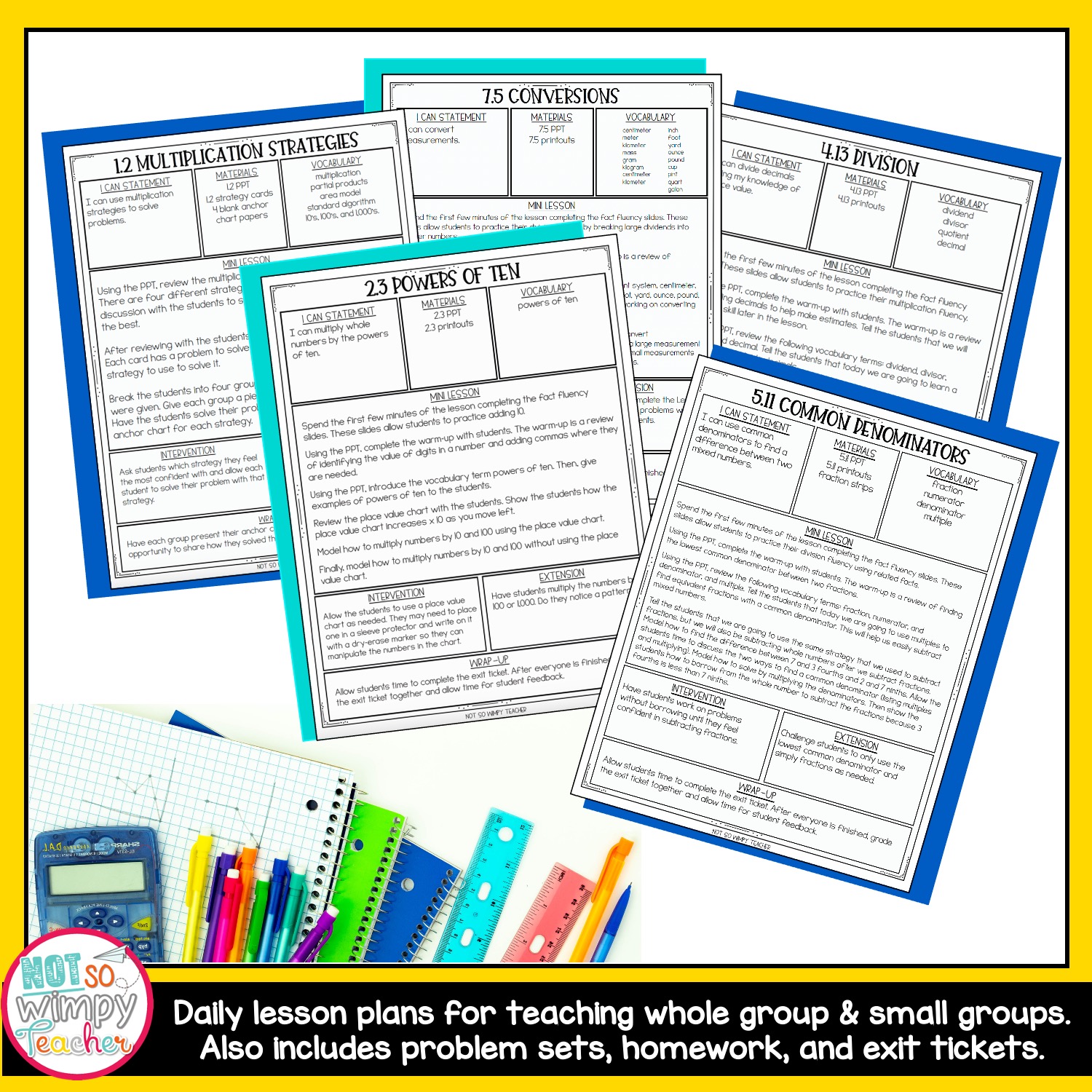
Daily lesson plans and activities for small group instruction make lesson planning a breeze.
Suggestions for intervention and enrichment make differentiation easy.
Graphic organizers and interactive notebooks for scaffolding students in learning new math concepts.
Instructional PowerPoints ensure that daily mini lessons are interactive and easy to prepare.
Each lesson includes student problem sets and homework.
Exit tickets for each lesson make share time easy and allow for quick formative assessments.
Helpful tools and resources
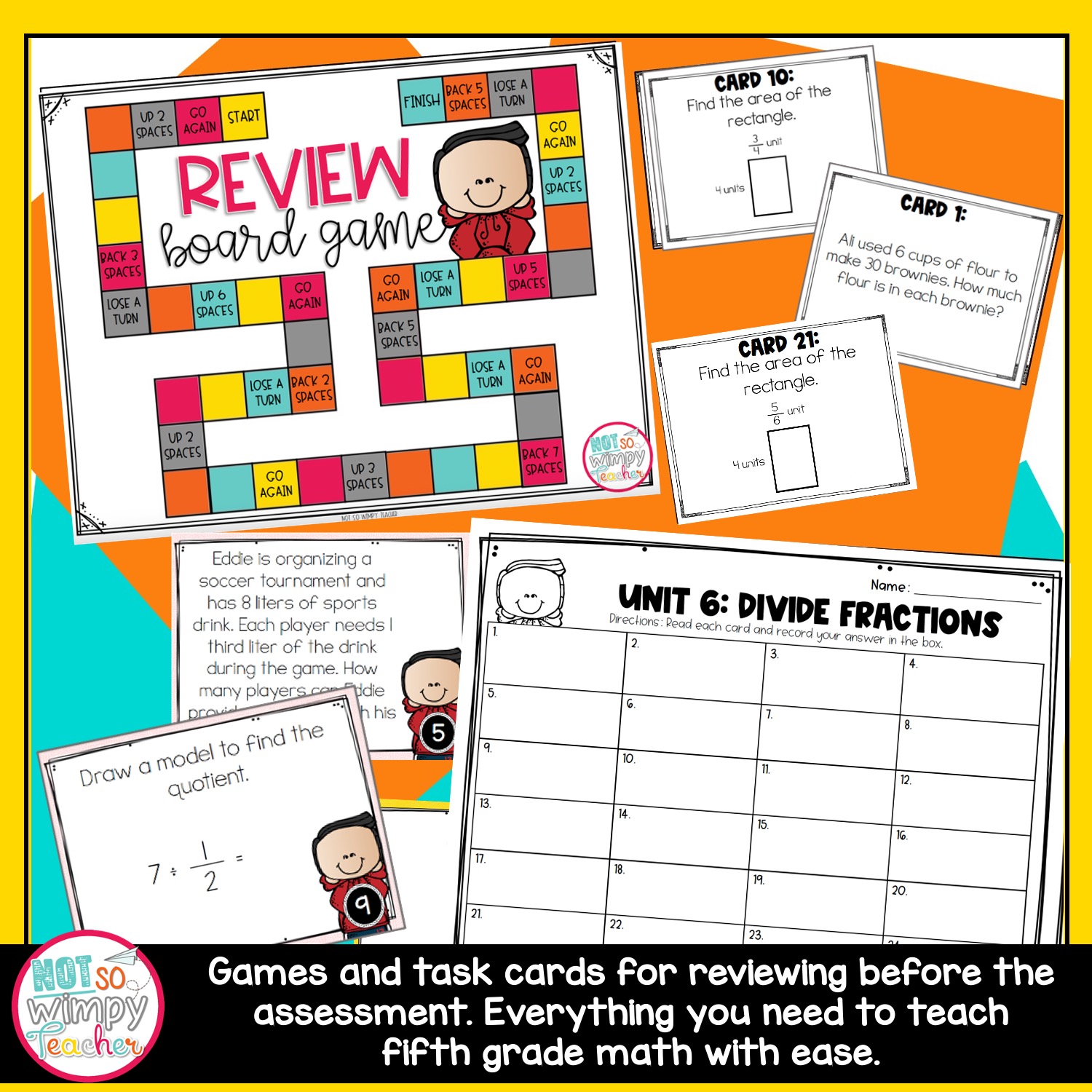
Math game to provide extra practice in a fun and engaging format that students love.
Level-up activities are included for enrichment.
Task cards are included for use in centers or as a whole group activity.
5 Project-based learning activities for hands-on, authentic math practice.
Math Test Prep Escape Room provides a fun and engaging review that will have your students hitting it out of the park on test day.
A comprehensive assessment with questions modeled after standardized tests allows students to practice important skills while you assess learning. We’ve also included a scoring rubric which makes it easy to see which skills students still need to master at a glance.
An FAQs section provides answers to commonly asked questions about the resource and helps you get started right away.
Unit 1: Back to School
Addition and Subtraction
Multiplication Strategies
Division Strategies
Fractions and Decimals
Ordering Fractions
Unit 2: Place Value
Days 1-2: Whole Number Place Values
Day 3: Multiplying Whole Numbers by the Powers of 10
Days 4-5: Exponents
Days 6-7: Decimal Place Values
Days 8-9: Multiplying Decimals by the Powers of 10
Day 10: Review
Days 11-12: Compare Decimals
Day 13: Order Decimals
Days 14-15: Round Decimals to the Nearest Whole Numbers
Day 16: Round Decimals to the Nearest Tenth
Day 17: Round Decimals to the Nearest Hundredth
Day 18: Rounding Decimals
Day 19: Word Problems
Day 20: Assessment
Unit 3: Whole Number Operations
Day 1: Estimating Products
Day 2: Multiply by Single-Digit Numbers
Day 3: Multiply by Multi-Digit Numbers w/Area Model
Day 4: Multiply by Multi-Digit Numbers
Day 5: Estimating Quotients
Days 6-7: Division with Partial Quotients
Days 8-10: Division with the Standard Algorithm
Day 11: Review
Day 12: Order of Operations
Day 13-15: Interpret Expressions
Day 16: Evaluate Expressions
Day 17: Write Expressions
Day 18: Word Problems
Day 19: PBL
Day 20: Assessment
Unit 4: Decimal Operations
Day 1: Add Decimals with Base Ten Blocks
Day 2: Add Decimals with the Standard Algorithm
Day 3: Subtract Decimals with Base Ten Blocks
Day 4-5: Subtract Decimals with the Standard Algorithm
Days 6: Review
Days 7: Multiply Decimals with Models
Day 8: Multiply Decimals by Whole Numbers
Day 9: Multiply Decimals by Decimals
Day 10-11: Dividing Decimals with Models
Day 12-13: Dividing Decimals with the Standard Algorithm
Day 14: PBL
Day 15: Assessment
Unit 5: Adding and Subtracting Fractions
Day 1: Estimating Sums with Benchmarks
Day 2: Addition with Models
Day 3: Addition with Models (Mixed Numbers)
Day 4: Finding Common Denominators
Day 5: Addition Using Common Denominators
Day 6: Addition Using Common Denominators (Mixed Numbers)
Day 7: Estimating Differences with Benchmarks
Day 8: Subtraction with Models
Day 9: Subtraction with Models (Mixed Numbers)
Day 10: Subtraction with Common Denominators
Day 11: Subtraction with Common Denominators (Mixed Numbers)
Day 12 & 13: Word Problems
Day 14: Review
Day 15: Assessment
Unit 6: Multiplying and Dividing Fractions
Day 1: Understanding Fractions
Day 2: Multiplying Fractions by Whole Numbers with Models
Day 3: Multiplying Fractions by Whole Numbers
Day 4: Multiplying Fractions by Fractions with Models
Day 5: Multiplying Fractions by Fractions
Day 6: Understanding Products
Day 7: Scaling
Day 8: Multiplying Mixed Numbers by Fractions
Day 9: Finding the Area of Rectangles Whole Numbers by Fractions
Day 10: Finding the Area of Rectangles Whole Numbers by Mixed Numbers
Day 11: Finding the Area of Rectangles Fractions by Fractions
Day 12: Finding the Area of Rectangles Mixed Numbers by Mixed Numbers
Day 13: Multiplication Word Problems
Day 14: Multiplication Review
Day 15: Interpret Remainders
Day 16: Divide Whole Numbers by Unit Fractions
Day 17 & 18: Divide Whole Numbers by Unit Fractions Word Problems
Day 19, 20, 21 & 22: Divide Unit Fractions by Whole Numbers
Day 23 & 24: Division Word Problems
Day 25: Division Review
Day 26: Multiplication and Division
Day 27 & 28: Multiplication and Division Word Problems
Day 29: PBL
Day 30: Assessment
Unit 7: Measurement
Day 1: Customary Conversions
Day 2: Customary Conversions
Day 3: Metric Conversions
Day 4: Metric Conversions
Day 5: Conversions
Day 6: Word Problems
Day 7: 2-step Word Problems
Day 8: 2-step Word Problems
Day 9: Line Plots
Day 10: Line Plots
Day 11: Solving Problems with Line Plots
Day 12: Solving Problems with Line Plots
Day 13: Solving Problems with Line Plots
Day 14: Measurement Review
Day 15: Assessment
Unit 8 Volume:
Day 1: Understanding Volume
Day 2: Understanding Volume
Day 3: Using Unit Cubes
Day 4: Using Unit Cubes
Day 5: Using Formulas (length x width x height)
Day 6: Using Formulas (length x width x height)
Day 7: Using Formulas (base x height)
Day 8: Using Formulas (base x height)
Day 9: Additive Volume
Day 10: Additive Volume
Day 11: Additive Volume
Day 12: Review
Day 13: Real World Objects
Day 14: Real World Objects
Day 15: Real World Objects
Day 16: Word Problems
Day 17: Word Problems
Day 18: Word Problems
Day 19: PBL
Day 20: Assessment
Unit 9: Geometry
Day 1: Classifying Triangles
Day 2: Classifying Triangles
Day 3: Classifying Triangles
Day 4: Investigating Quadrilaterals
Day 5: Classifying Quadrilaterals
Day 6: Classifying Quadrilaterals
Day 7: Classifying Quadrilaterals
Day 8: Review
Day 9: Introducing the Coordinate Plane
Day 10: Understanding the Coordinate Plane
Day 11: Understanding the Coordinate Plane
Day 12: Determining Points on the Coordinate Plane
Day 13: Plotting Points on the Coordinate Plane
Day 14: Plotting Points on the Coordinate Plane
Day 15: Problems on the Coordinate Plane
Day 16: Problems on the Coordinate Plane
Day 17: Generate Number Patterns
Day 18: Generate Number Patterns
Day 19: Generating and Plotting Number Patterns
Day 20: Generating and Plotting Number Patterns
Day 21: Word Problems
Day 22: Word Problems
Day 23: Word Problems
Day 24: PBL
Day 25: Assessment
Unit 10: End of Year Review
Day 1: Place Value
Day 2: Place Value
Day 3: Whole Number Operations
Day 4: Decimal Operations
Day 5: Decimal Operations
Day 6: Add Fractions
Day 7: Subtract Fractions
Day 8: Multiply Fractions
Day 9: Multiply Fractions
Day 10: Divide Fractions
Day 11: Divide Fractions
Day 12: Volume
Day 13: Conversions
Day 14: Coordinate Plane
Day 15: Escape Room Review
How to Use It in the Classroom:
You can use the PowerPoint mini-lesson for your whole group instruction. Project on the whiteboard and have students participate in the interactive lesson.
Complete class activities as a whole group, independently, or with partners.
Introduce the workshop model and meet with small groups of students each day. Don’t worry about these being your regular groups yet. Just get kids used to working independently on the activities while you meet with small groups. As a bonus, you get to see some of your students’ mathematical thinking up close.
Differentiation is easy with directions for intervention, on-level, and enrichment activities.
Take a few minutes to share at the end of class. Students will enjoy getting to share what they learned and learning a little bit about their new classmates.
Each mini-lesson will take about 20-30 minutes and you will need an additional 40-60 minutes for small group work and centers.
❤️❤️ Why You Will LOVE This Resource ❤️❤️
The 1-page lesson plan so you don’t have to sift through 6-8 pages
Done-for-you PowerPoint that you can open and go — letting it guide your whole-group lesson
Detailed small group lesson plans that include intervention and enrichment suggestions (this is NOT usually in math curricula)
Hands-on learning activities


