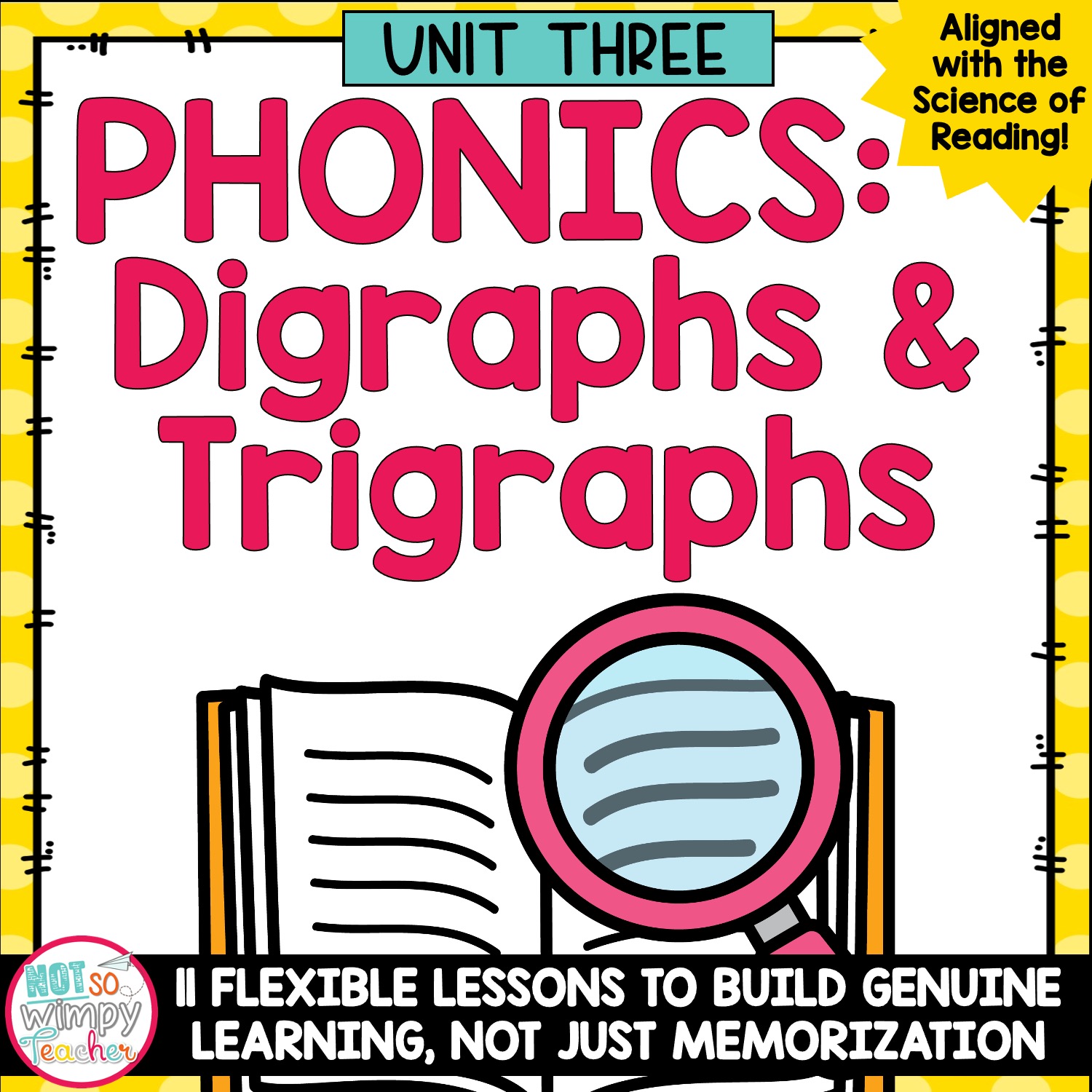
This 11-lesson digraphs and trigraphs unit takes students past sound-mimicking and into real pattern recognition. Students will build genuine digraph-vs-blend understanding, learn the “new sound” patterns (sh, th, ch, wh, ng) and the “known sound, new spelling” patterns (ck, tch, dge, ph) as two distinct skills, with built in explicit discrimination practice most units skip entirely.
Phonics Skills: Digraph & Trigraph Words for Grades 2-5
Save MORE with Lesson GenieMore about this resource
Sh, ch, th, wh… students can often mimic these sounds without ever realizing two letters are teaming up to make them. Even fewer can tell you why “chip” and “ship” sound so different despite looking so similar, why c-k shows up at the end of “duck” instead of just k, or why d-g-e spells the same sound as the letter j.
This 11-lesson digraphs and trigraphs unit takes students past sound-mimicking and into real pattern recognition. Students will build genuine digraph-vs-blend understanding, learn the “new sound” patterns (sh, th, ch, wh, ng) and the “known sound, new spelling” patterns (ck, tch, dge, ph) as two distinct skills, with built in explicit discrimination practice most units skip entirely.
Grounded in Science of Reading research, this unit works as Tier 1 whole-group instruction for a 2nd grade classroom or as small-group intervention material for grades 3-5 students working below grade level.
What’s Included
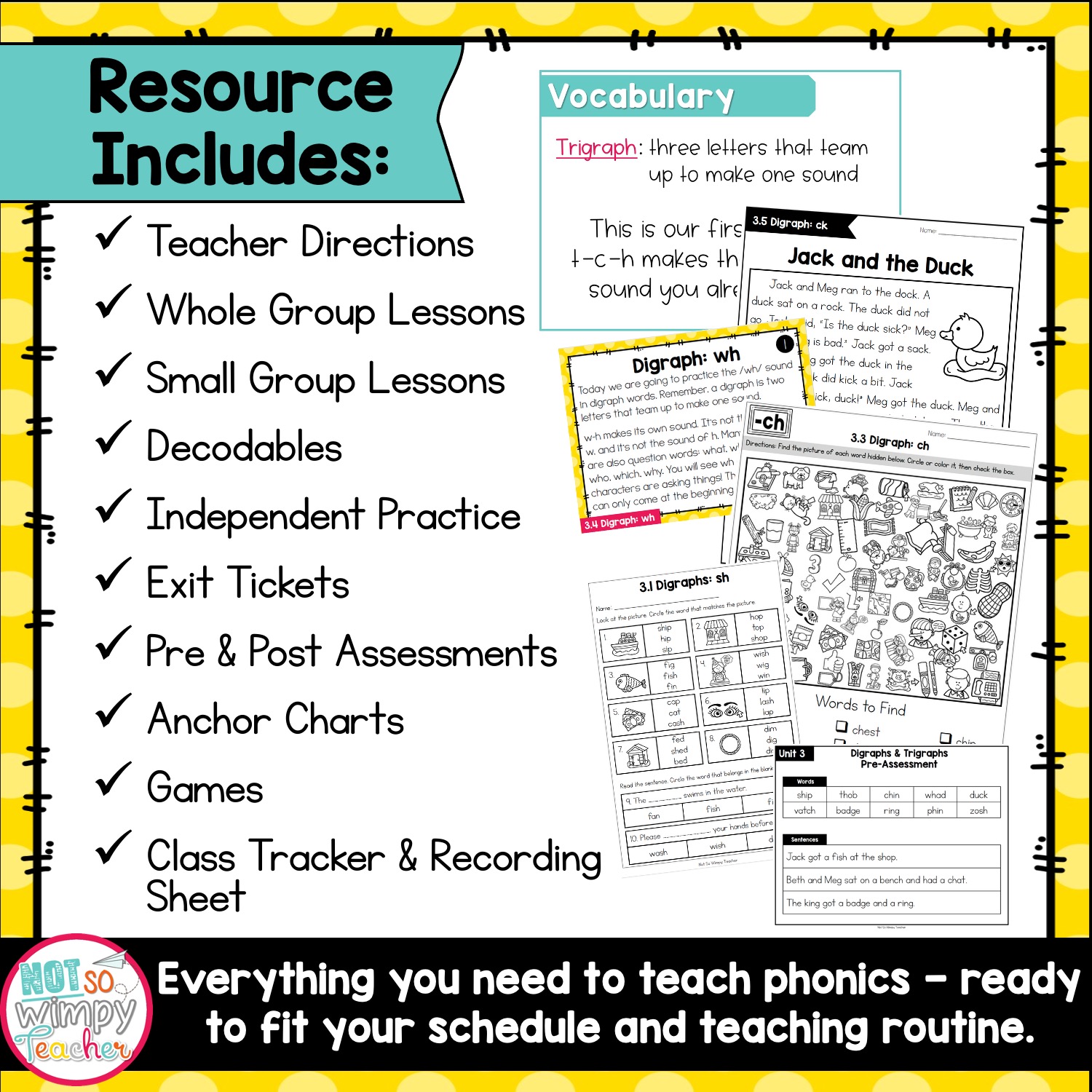
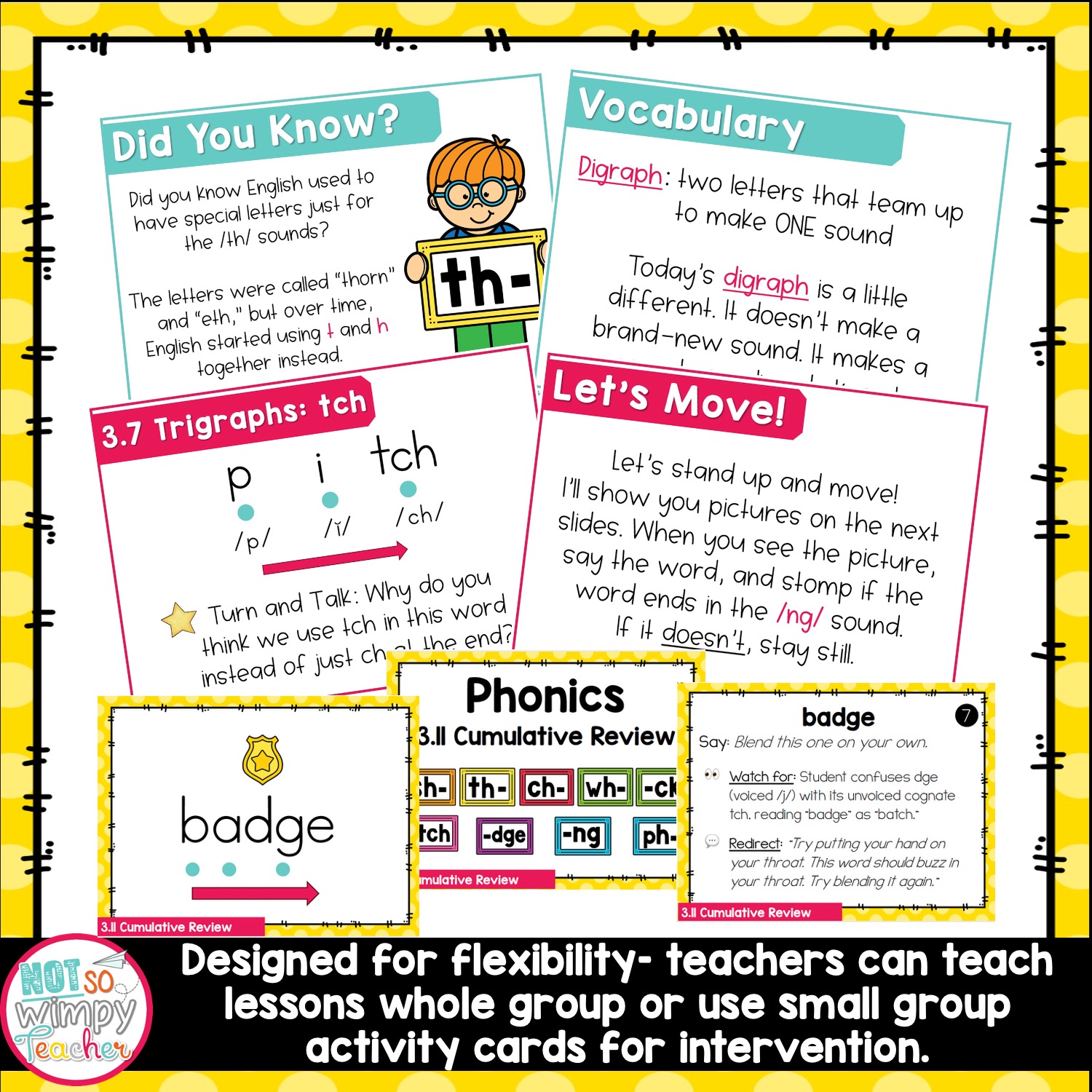
- 11 Whole-Group Lesson PowerPoints- a consistent 25-slide structure (Did You Know? hook, review, explicit “name the pattern” instruction, modeled/guided/partner blending practice, a movement break, and a closing Turn and Talk) for every pattern: sh, th, ch, wh, ck, a mixed-pattern review, tch, dge, ng, ph, and a cumulative review
- 11 Small-Group Card Decks- picture word cards with dot-scaffold blending support, Watch For/Redirect teacher-script cards built around each pattern’s real, documented error types (voiced/unvoiced th, sh/ch crossovers, b/d reversals, and more), a grayscale printing option, and nonsense word cards for transfer practice
- 11 Sets of Independent Practice- matching, sound fill-in, and picture-based practice pages for every lesson, with answer keys
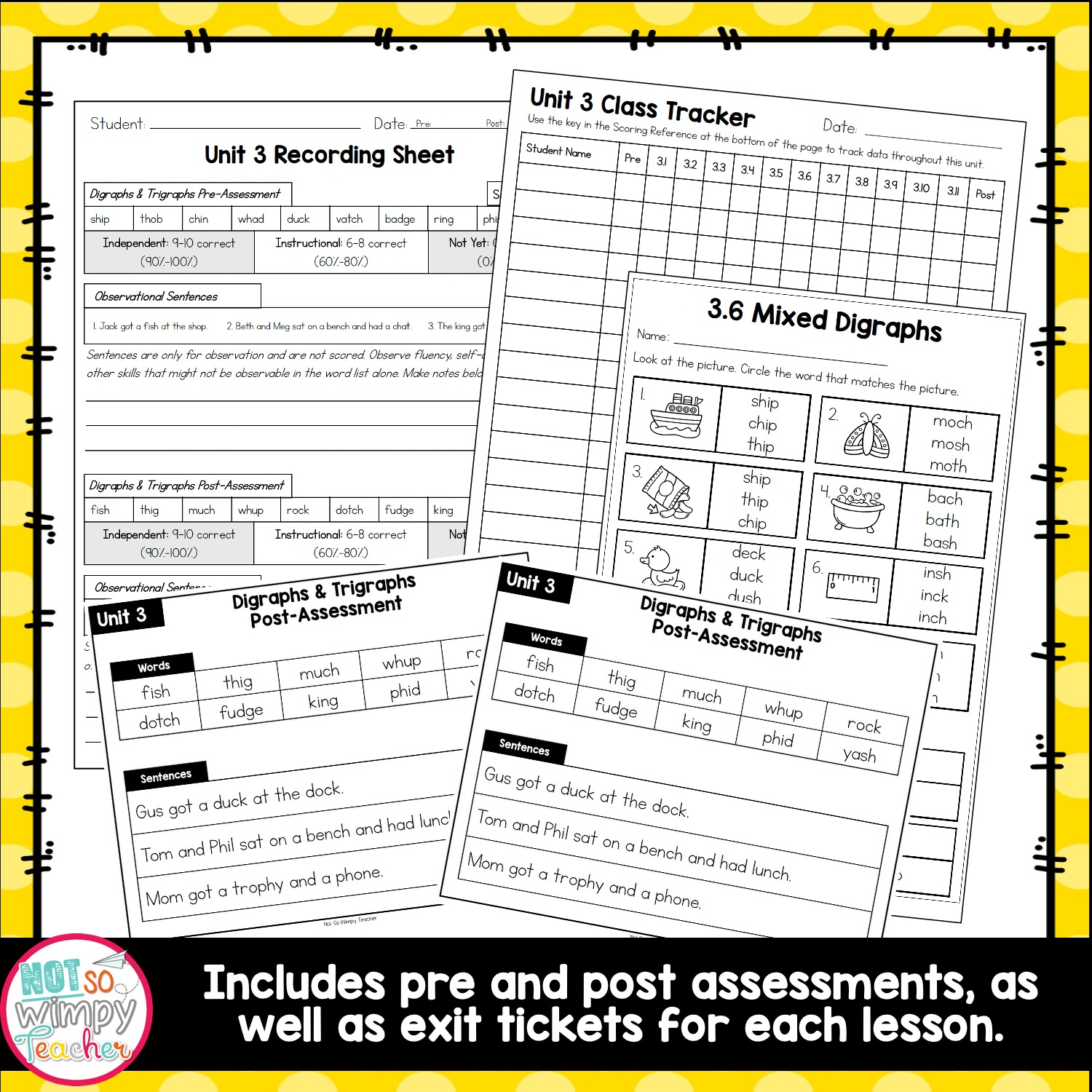
- 11 Written Exit Tickets- a picture-match plus sentence-cloze checkpoint after every lesson
- 11 Decodable Passages- original stories using a recurring cast of characters, built strictly from only the patterns taught by that point in the sequence, each with a fluency tracker and an answer key
- Bingo for every lesson- 36 unique boards plus a teacher calling card, sized to fit each pattern’s real word pool
- Digraph Race board game- a board game with Read It!, Fix It!, and Challenge card decks, adapted specifically for digraph discrimination
- Anchor charts for every lesson
- Pre/Post Assessment- 10 words (real and nonsense) plus 3 sentences for fluency observation, with a matching scoring key
- Read First Teacher Guide- includes a dedicated Digraphs & Trigraphs section explaining the sequencing logic, plus lesson-specific guidance for the patterns with thinner word pools (wh, dge, ph)
Skills Covered
- Blending CVC words across all five short vowel sounds
- Discriminating between the vowel pairs students confuse most (a/o, i/u, and i/e)
- Decoding real words and nonsense words with equal accuracy
- Reading CVC words inside connected text, not just in isolation
- Self-monitoring using sentence context to catch decoding errors
- Progress monitoring aligned to the same mastery language used across the whole Screener
Unit Lessons
- Lesson 1: Digraphs sh
- Lesson 2: Digraphs th
- Lesson 3: Digraphs ch
- Lesson 4: Digraphs wh
- Lesson 5: Digraphs ck
- Lesson 6: Digraphs Mixed Review
- Lesson 7: Trigraphs tch
- Lesson 8: Trigraphs dge
- Lesson 9: Digraph ng
- Lesson 10: Digraph ph
- Lesson 11: Cumulative Review
How to Use in the Classroom:
Designed to be taught as an 11-lesson sequence, with the pacing (one lesson per day, or stretched across a longer block) left to you.
- Whole Group (~30-40 min): Teach the full lesson as scripted using the slide deck, then follow with independent practice and the exit ticket.
- Small Group (~15-20 min): Use the condensed card deck instead of the slides. Follow the I Do / We Do / You Do / transfer structure built into every deck.
- Mixing Both: Use whole-group delivery for your full class, then pull specific students for small-group reteaching with the card decks. Both paths teach identical content.
- Games: Use Bingo or Digraph Race for center rotations, fast finishers, a dedicated review day, or extra practice before small-group reteaching.
Differentiation
- Every Watch For/Redirect card names a specific, real misconception (not a generic hint) and gives exact corrective language to use in the moment.
- Lessons with thinner real-word pools (wh, ph) include Say-only teacher-modeling cards for words containing patterns not yet taught, so students get guided exposure to useful vocabulary without being asked to decode independently before they’re ready.
- The cumulative review lesson (3.11) uses a self-monitoring “does this make sense?” approach.
- One resource works across a 2nd-5th grade team: the same 11 lessons serve as core instruction for a 2nd grade classroom and as intervention content for older students who need this skill.
❤️ ❤️ Why You’ll Love It: ❤️ ❤️
- No-prep, print-and-go lessons covering all 11 digraphs and trigraphs students need before moving into blends
- Goes beyond “sound it out,” students learn to distinguish new-sound patterns from known-sound spelling rules, which sets them up to actually reason through unfamiliar words instead of guessing
- Every Watch For card is built from a real, documented error pattern (voiced/unvoiced th confusion, sh/ch crossovers, the “expects a new sound” ck/tch/dge misconception), not a generic placeholder
- Honest, teacher-facing notes flag exactly where a lesson’s word pool runs thin (wh, ph) so you know when to lean on guided modeling instead of independent practice
- One resource works across a 2nd-5th grade team, with the same structure and skills at every grade band
Phonics Skills Unit Pacing
Before beginning instruction, use the Phonics Skills Screener to determine each student’s starting level. The screener helps identify which phonics skills students have mastered and which skills they still need to develop, so you can begin instruction at the appropriate unit rather than having every student start at the same place.
Use the corresponding unit for targeted instruction and practice.
The full phonics curriculum will include 11 skill-based units, with Unit 1: Phonemic Awareness planned as a final unit for students who need intensive foundational remediation.
- Unit 2: CVC Words
- Unit 3: Digraphs & Trigraphs
- Unit 4: Blends — Coming soon!
- Unit 5: CVCe — Coming soon!
- Unit 6: Vowel Teams — Coming soon!
- Unit 7: R-Controlled Vowels — Coming soon!
- Unit 8: Diphthongs & Other Vowel Sounds — Coming soon!
- Unit 9: Advanced Phonics Skills — Coming soon!
- Unit 10: Multisyllabic Words — Coming soon!
- Unit 11: Morphology — Coming soon!
- Unit 1: Phonemic Awareness — Coming later as an intensive remediation unit